Contractor Website vs Landing Page: Which Does Your Business Need?
Choose the right contractor website or landing page by matching it to your services, traffic source, customer questions and enquiry process.
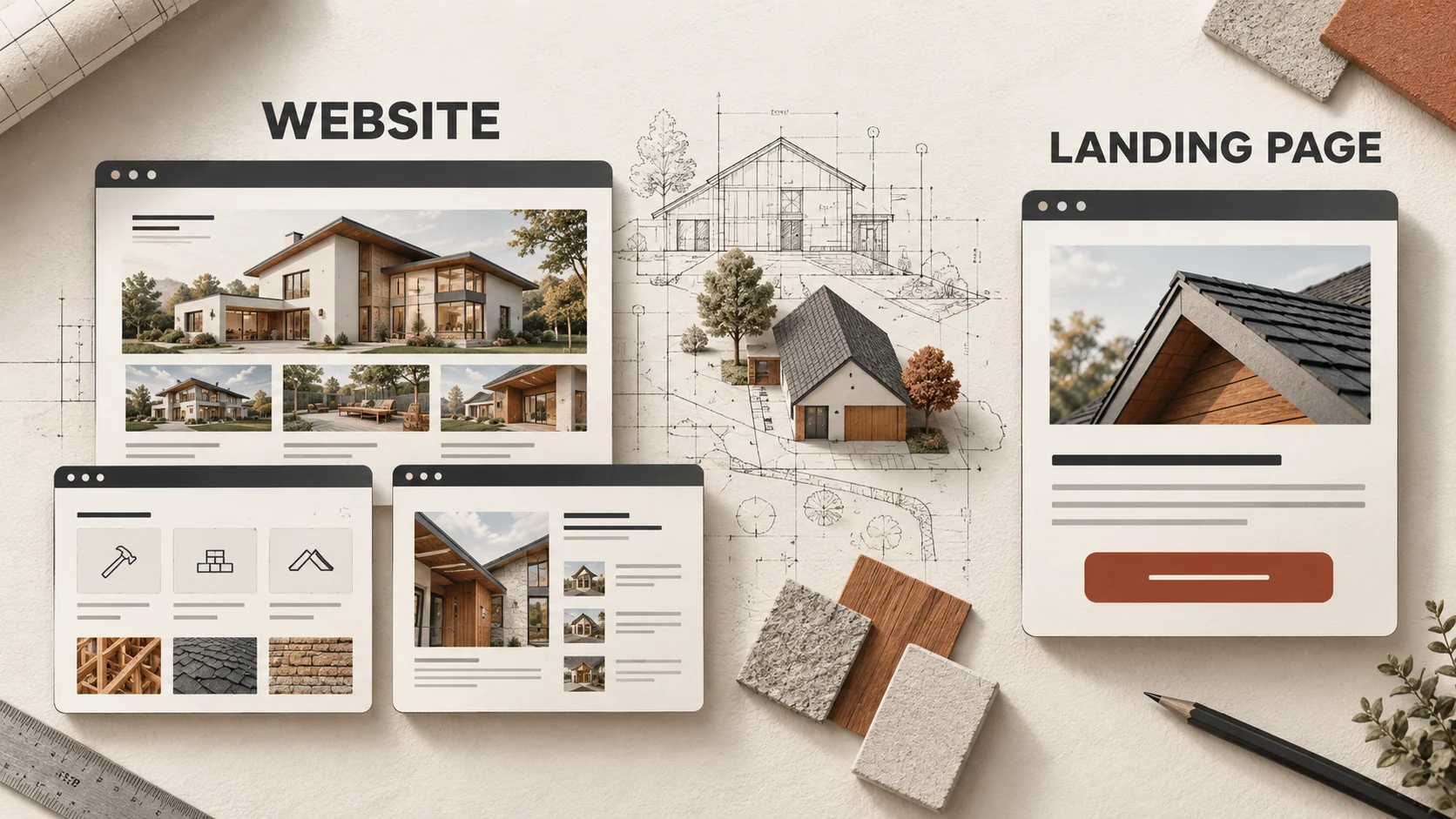
Build a contractor website when customers need to compare your services and assess your work. Use a focused landing page when you are promoting one service to a specific audience. Before paying for both, check whether an existing service page can handle the campaign.
A homeowner researching a home extension needs different information from someone responding to an advert for a roof inspection. Your page should help that person decide whether to contact you.
What does each option do?
A contractor website brings your business information together: services, completed projects, coverage, team, and contact details. It gives customers several routes to find the information relevant to their job.
A campaign landing page concentrates on one offer and its next step. It can sit within your website and still include project evidence, customer questions, and enough detail to support the decision.
| Consideration | Contractor website | Campaign landing page |
|---|---|---|
| Customer need | Understand the business and explore suitable services | Evaluate one service or offer |
| Typical traffic | Referrals, business-name searches, service searches | A relevant advert, email, or promotion |
| Content scope | Service pages, projects, business information, contact routes | Offer, relevant proof, questions, enquiry action |
| Navigation | Links between related pages | Fewer competing choices, with useful trust information accessible |
| Upkeep | Maintain services, projects, coverage, and business details | Maintain the offer, availability, form, and campaign tracking |
“Landing page” can also mean any page someone reaches after clicking an advert. That includes a normal service page. Google Ads uses this broader definition; here, the comparison is with a page designed for a particular campaign. Google Ads’ definition
Build the website first when customers need more context
Prioritise your website if referrals lead people to incomplete information, your services are unclear, or customers cannot find examples of the work you want to win.
Imagine a builder offering extensions and bathroom renovations. Someone considering an extension may want to understand how the builder approaches access, disruption, and project planning. A bathroom customer may be looking for relevant layouts, finishes, and scope. Separate service and project pages give each enquiry room to develop.
Start with the information those decisions require. You do not need a large site simply because you offer several services. Use the contractor website checklist to identify missing information before deciding on a rebuild.
Add a landing page when the campaign needs a different conversation
A focused page is useful when your campaign has a specific promise that the current site does not explain clearly.
For example, a roofing company’s general service page might cover repairs, replacements, and inspections. An inspection campaign needs to make the inspection scope, service area, any charge, and booking process easy to find.
Google recommends aligning the destination with the advert, keywords, and call to action. This supports a relevant experience; a separate landing page does not automatically produce better results. Google Ads’ guidance
Read your existing service page alongside the advert. If they already tell a consistent story and the next step is clear, improve that page. Build a separate destination when the offer, audience, or enquiry process genuinely differs.
Connect the page to a working enquiry process
Once you know which page you need, define what happens after someone responds. This is where Funnelphilia connects website copy and design with forms and follow-up.
For a hypothetical renovation campaign, the journey could be:
- Explain the fit. State the renovation work, coverage, and project types the contractor accepts.
- Support the decision. Show relevant, authorised project photographs and explain the work completed.
- Collect useful details. Ask for contact information, project location, and a brief description.
- Confirm and assign. Acknowledge receipt, state a realistic response expectation, and send the enquiry to someone responsible for replying.
An urgent repair service needs a different route, with clear operating hours and an accessible phone contact. The process should reflect how the contractor actually works.
Compare quotes on that complete scope: copy, evidence, forms, routing, testing, ownership, and maintenance. Then measure suitable enquiries and booked work. A form submission count alone does not tell you whether the page attracted jobs you can serve.
Frequently asked questions
Can I start with one page and expand later?
Yes. A focused page can be a practical starting point for one service. Keep control of your domain and content, and choose a setup that allows additional service and project pages when needed. You still need a way for customers to discover it.
Which option helps with search and AI answers?
A website offers room for several services and questions; a landing page can answer a narrower need. For Google’s AI Overviews and AI Mode, SEO fundamentals still apply, and supporting pages must be indexed and eligible for a search snippet. Neither format guarantees inclusion. Google’s AI search guidance
What should you build next?
Choose a website to give customers the context and proof they need across your services. Add a focused landing page when a campaign needs a distinct offer or enquiry route. Check the pages you already have before commissioning more.
Share your current website, the service you want to grow, and how customers find you with Funnelphilia. We can help you connect the right page, message, and follow-up process.
Keep exploring.
More ideas, real projects and practical guides from Funnelphilia.
Back to blog